Friday, May 22, 2009

Training

The Home Based Care & Counselling training is off to a great start!

We began on Wednesday evening and Thursday (a public holiday here) and will continue tonight, Saturday, Sunday afternoon and Monday (another public holiday). The topics already covered include:
§ The roles of caregivers and counselors
§ Basic facts about HIV-AIDS
§ HIV transmission and prevention
§ Social factors that contribute to the spread of HIV
§ Stigma and discrimination
§ How to live positively with HIV.


Some of the participants

After that more introductory information, we’ll start with the topic of Home Based Care tonight.

There are 15 participants, 13 from the church and two from the community. As I’ve mentioned before, EBC members are also doing most of the training; so far we’ve had 5 different presenters, as well as Julia, the trainer from AIDS Care Trust.


Edler presenting "How to live positively with HIV"


The temperature is a bit chilly in the evenings, but everyone’s keeping warm with plenty of tea and coffee!

Sunday, May 3, 2009

Support...group

Well, as promised last week, some news about our second support group meeting for our Home Based Care clients.

The group met on 29 April and again really enjoyed their time together. Jogbeth and Aline led the meeting; five clients attended and one client also brought along her daughter.


The five clients together with Aline at the meeting

From the start of our planning for a Home Based Care Program, we felt it was important to work towards starting a support group. Carers visit the clients, normally once a week, and can be a real help and encouragement to them in their homes. But unless the Carer is also living with HIV or AIDS and in a similar situation, they can’t really know what their clients have to face everyday.

In a support group the members can help and encourage each other in a different way because often they have like experiences and face the same circumstances. When two of the newer clients met each other at this group they were so surprised – “Oh, are you also a part of this group?” They already knew each other from meeting at the hospital for treatment, or at the clinic to collect their medication. Learning how someone else has practically dealt with an issue or condition can be invaluable in tackling it yourself – much more than hearing, “This is what I think you should do…”.


Together we are strong!

The clients are already interested in gathering more often than the current plan for once-a-month meetings, so we’ll have to see if more frequent meetings are possible.

Training
As the Home Based Care is expanding, more people in the church are expressing interest in it. So we are holding Home Based Care training from 21 to 25 May, especially structured on evenings, public holidays (the 21st and the 25th) and the weekend so that even people who are working will have a chance to come. So far there are 16 people who are interested in attending!

Those of us who have completed the course previously will have a greater opportunity to lead some of the training this time also. We have a great partner organization in the AIDS Care Trust and they are constantly encouraging us to upgrade our training skills. So I am in charge of the training program and next week Jogbeth and I will finalize the planning and see who can be involved in leading the different topics.

Saturday, May 2, 2009

Workshop!

The school holidays mean quieter afternoons because there’s no After School Program, but there’s still plenty happening.

Wednesday saw the second support group meeting for the Home Based Care clients, I hope to blog about that next week. There’s also planning going on for training in Home Based Care at the end of the month; the aim of the training is to have more qualified people to be able to care for clients so we can reach more people with this great program.

And Tuesday was a skill-building workshop for the After School Program volunteers. We started off with a breakfast together of brötchens (bread rolls) and coffee (which, I admit, was a ploy to make sure everyone was early so we could start on time at 9am – and it worked!). The first topic was Preparation, and Tangee spoke to the volunteers on the role of preparation in lesson and activity planning, how it should be done, and how proper preparation can benefit everyone involved.

Earnest discussion (from left) Tangee, Sutuu, Lazarus, Zeka, Joseph, Mercia, Steven, Absalom, Gebby, Uvatera

Our second speaker, Mrs Mbuende (one of the church members who’s a primary school teacher), was a bit late as she had to come straight from school. (Although the children are on holidays, the teachers were working up until Wednesday.) She gave insights into the best way of helping children in different grades with their homework; and the volunteers were able to ask questions about specific problems they had noticed. Mrs M also gave more information about what and how the children learned at school, and how the volunteers can help the children learn.

Next on the program was skills in talking to children about their problems and Vikki from Scripture Union did an excellent job of outlining listening and responding skills, as well as some basic counselling. That was the theory, and then we broke for lunch.


Vikki shares her knowledge
After the meal, a bit of a stretch, and (for some…) a bit of a nap (!), Vikki took us through some case studies and practical examples before she had to go. Then it was my turn to talk about HIV and AIDS, focusing more on the technical side of how HIV works in a human body, the different stages of HIV infection and how the body responds to these, as well as the approaches to HIV prevention that are being used in Namibia. Of course there was a lot of discussion on these points and we ran out of time!

To give the volunteers something to keep them busy over the holidays, there was also a practical assignment. Over the next three weeks the volunteers, in pairs, must prepare a talk on HIV-AIDS to present to the youth at church. They were given additional materials to help them, and hopefully by reading the information they will also learn more facts about HIV and AIDS.

There is constantly more information coming out, and being discovered, about HIV and AIDS and one thing I’ve learnt is the importance of keeping up to date with this. It’s easy to hear so much about HIV or AIDS that you tend to tune out after a while, but because of the ongoing research into a cure the scientists and researchers are always learning something new.

Long weekend
Here in Namibia we have a double long weekend – celebrating Workers Day on Friday and Cassinga Day (commemorating an important battle in Namibia’s independence struggle) on Monday. Jimmy is out of town for a family funeral but friends Vasisee and Kauna and I took my girls on a ‘short’ 3 km hike today at a local wildlife park. It did feel longer than 3 kms…
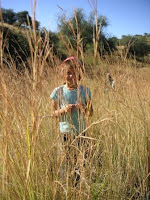
Samara’s 1.25m tall, so that’s some LONG grass!

We saw some wildebeest, oryx and red hartebeest, but not near enough to photograph nicely. (Of course my camera was put away when a wildebeest – gnu – trotted along next to the car on our drive out of the park!) The hike took us to a small dam and it was certainly beautiful scenery on a cool sunny day.
The view at the dam

Saturday, April 25, 2009

End of term already?

After School Program closed for Term 1 on Thursday. Strangely enough, it was a rainy afternoon! Namibia’s right at the end of the rainy season and though we might get some light showers into May, the heavy thunder showers we had on Wednesday and Thursday are quite unusual. The rain has ushered in some chilly nights and cool days – at least by Namibian mid-Autumn standards!

Attendance at the Program dropped off following Easter as the children were busy with exams but the average daily attendance in February and March was 69. March saw the highest attendance figure on one day of 90 children!

The school holidays are for four weeks so the children will only be returning to school on 26 May. Next week we’re holding a mini-workshop for the After School volunteers to build their skills in working with the children, then they’ll have a well-deserved break before planning for Term 2 takes place the week before school starts.

Home Based Care
In the last month or so, Jogbeth and Aline have contacted two new clients each, which brings the total of clients being visited weekly by the three ladies to 12.
The first support group meeting for the clients was held at the end of March. An HIV-AIDS support group is important for those living with HIV and AIDS to be able to share experiences, support and encourage each other. Three clients and two Carers attended the meeting and they had a great time of fellowship. We’d like to start having these meetings on a monthly basis, so please pray that more clients will be able to attend the next one.

Friday, April 17, 2009

No longer home alone

“I really like it here,” Tjingaitjita says earnestly. “As well as my homework I get help with extra English and Maths – that’s important for school you know.” Never silent for very long, his sister, Hitjitevi, chimes in, “And the singing! I like the singing!”

Tjingaitjita, who’s in Grade 4, and Hitjitevi, Grade 3, started coming to the After School Program (ASP) at the beginning of this year. They refused to go to the previous after school care they attended because it was “boring” and their older sister was desperate to find a program that would help them with their schoolwork.

Their cousin Sutuu, who is a volunteer helper at the ASP explains, “Their mother passed away last year and so they are living with their father and sister. Their father works and their sister is in her third year of studying law, so most of the time there’s no one at home when they come back from school. I told the sister about EBC’s Program and asked her to try it – after all, it’s also very close to where they live. So they started coming.”

The children have been attending the ASP for two months now and their sister is happy with their progress. “Tjingaitjita and Hitjitevi like it and find it helpful…[on most days] they get all their homework done…I’m now waiting to see the results on their school reports at the end of term.”
Hitjitevi (left) and Tjingaitjita get some help from Mercia
She also thinks that what they learn about the Bible at the ASP is very important. She is a Christian but their father isn’t, so she tries to teach the children about the Bible but often does not have enough time. Now she can see that their understanding is growing through the weekly Bible Club lessons.

I ask the children what activities they enjoy at the ASP. “Sports!” says Tjingaitjita. “And the Bible Club, I like learning the verses and learning about God.” When I ask why it’s important to know about God, he thinks for a moment and then says, “If you don’t live the way God wants you to, you’re probably going to do bad stuff and go to prison.”

“Yes,” says Hitjitevi, “learning about the Bible helps you not to be bad to other people but treat them nicely.”

Friday, April 10, 2009

After School Parents' Evening

A happy and blessed Easter to everyone! Although I’m out in the bush for our church’s Easter Camp, thanks to the marvels of modern technology I can also post this.

On Monday evening we had a parents meeting for After School. About 25 parents and 65 children came and we had a great time.

Tangee was officially introduced as the new Coordinator and told the parents a bit about what their children actually do at the Program. The children had practiced three songs (under Lazarus's patient direction) and the parents really enjoyed their singing.

Two of the “littlies” in Grade 2 said memory verses from Bible Club lessons and some of the children from the Life Skills group performed a drama based on what they learn in the lessons about choices, standing up to peer pressure and abstaining from sex.
Tangee provides some moral support for Queeny as she says her memory verse

The children also got a chance to talk, with George (Grade 8), Kapaa (Grade 8) and Kuvaza (Grade 7) saying what the Program means to them. They talked about what they enjoy at the Program – the different activities and the help they get with their schoolwork. Kuvaza was introduced as the “After School Veteran” as she’s been attending ever since the Program started in 2004 – when she was in Grade 2!
(Top to bottom) Kuvaza, Kapaa and George

Then it was the parents’ turn and it was hard not to get emotional when George’s mother stood up and talked about the change the Program has made in the lives of her children (she has three sons). Before George started at the Program, she said, he was failing at school and didn’t care – when he came home from school he would just play soccer with other kids in the street instead of doing his homework. But after coming to the Program he managed to pass at the end of that year (2007) and has been doing well ever since. Now when he comes home from school he grabs his books and is eager to get to the Program.

The parents were unanimous in their thanks and encouragement to keep the Program going, to help their children.

After a cup of coffee and some cookies for everyone, the evening was declared a success…and then we had to clean up!

Zeka seemed to enjoy washing all those cups!


Saturday, April 4, 2009

A positive change

From Jennifer, one of our home based care clients:

I am a 30 year old female Namibian and I am HIV-positive. I’ve been living with HIV for about 10 years now and lost my second-born child to HIV-AIDS. I’ve been diagnosed with full-blown AIDS and am receiving antiretrovirals as treatment.

Since I have been introduced to the EBCAIDS Home Based Care my life has improved tremendously. This is due to the food, love and support I receive from this ministry. I currently do not have a job and through the Home Based Care visits I have been encouraged and counseled to live positively even in the face of this, and other, difficulties. I really thank God who keeps me alive day after day, and because He has used His servants from EBCAIDS to help me accept my condition and live a happy and productive life.


Aline has been visiting Jennifer for about seven months now. Jennifer lives by herself (her first child stays with his father) and she often got discouraged by the emotional and health problems that come along with HIV-AIDS. Since Jennifer has been receiving the home based care, Aline has seen a real change in her attitude and life.

“She is a lot more positive now that she can talk about her problems with someone. It also helps that we pray about the issues she has to deal with and I encourage her that God hears our prayers and will answer them,” Aline says. “Also since I started visiting her Jennifer has started her own small business of taking wedding photos. This means that she isn’t just depending on the food that I bring her each month, but is also able to make some money for herself. That has really improved her outlook on life.”